
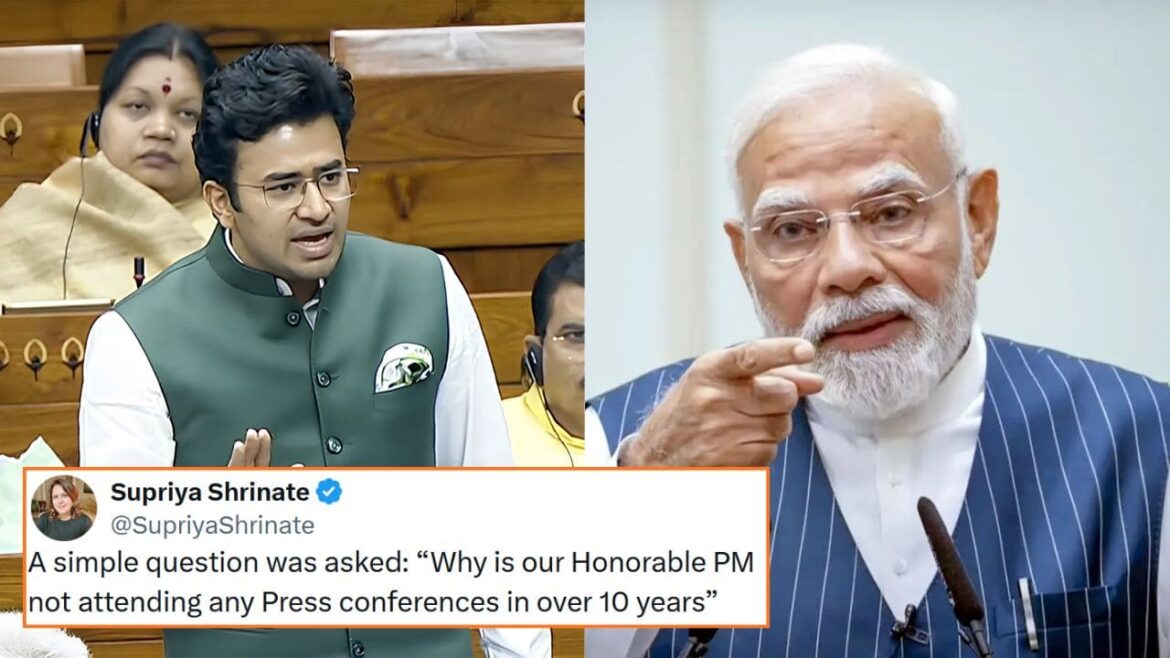
Political discussions often become viral in India, especially when leaders interact directly with young audiences. A recent interaction involving BJP MP Tejasvi Surya has once again brought attention to an old public debate — why Prime Minister Narendra Modi rarely conducts traditional press conferences.
During a student interaction event in Bengaluru, Surya was asked a direct question about communication, democracy, and media access. His answer quickly spread across social media and triggered mixed reactions.
A Student Asked A Question That Started A Bigger Debate
🚨GenZ Kid Rock – Diaper Kid Shock 🚨
Diaper kid Tejasvi Surya was shocked when a GenZ student asked “Why is our Honorable PM not attending any Press conferences? ”
Teju tried to beat around the bush instead of answering the question. pic.twitter.com/zvektUMFE8
— 👑Che_ಕೃಷ್ಣ🇮🇳💛❤️ (@ChekrishnaCk) June 19, 2026
During an open discussion session at a college event, one student asked Tejasvi Surya why Prime Minister Narendra Modi had not regularly appeared in press conferences despite leading one of the world’s biggest democracies.
The question immediately grabbed attention because it reflects a discussion that has been happening in public and political circles for many years.
Many people believe press conferences are important because journalists can ask unscripted questions. Others believe modern leaders now use direct communication methods that reach more people instantly.
Tejasvi Surya Explained Why He Thinks Press Conferences Matter Less Today
Responding to the student, Tejasvi Surya appreciated the question and argued that political communication has changed in the digital era.
According to Surya, leaders today can directly reach citizens through social media platforms, public speeches, radio programmes, interviews, digital campaigns, and live broadcasts.
His main argument was that communication no longer depends completely on traditional media channels.
He suggested that direct public outreach allows leaders to connect faster and more frequently with people.
How Political Communication Has Changed Over The Years
Politics has changed significantly in the internet era.
Earlier, newspapers and television interviews were considered the main communication tools. Today, leaders across the world use:
Social Media Platforms
Messages can reach millions instantly.
Video Addresses
Leaders can explain policies directly.
Public Events
Large rallies and public meetings attract massive attention.
Digital Campaigns
Citizens receive updates without waiting for news coverage.
Supporters of digital communication believe this creates a stronger direct connection.
Critics argue that press conferences still remain important because they allow questioning and accountability.
Internet Reacted In Different Ways
As expected, social media users had different opinions.
Some users agreed with Surya and said leaders should use platforms where people already spend time.
Others argued that press conferences cannot be replaced because journalists provide public questioning and independent scrutiny.
Many users also appreciated the student for raising the question openly.
The discussion became less about one person and more about how modern politics should communicate.
Why Press Conferences Still Matter In Democracies
Political experts often say press conferences serve a different purpose compared to speeches.
Press conferences usually allow:
Direct Questions
Journalists can ask follow-up questions.
Public Accountability
Leaders respond publicly.
Clarification
Complex topics can be discussed in detail.
At the same time, digital communication helps leaders reach people quickly without editing delays.
Because of this, modern politics now often combines both approaches.
The Bigger Conversation Beyond The Viral Moment
This viral exchange highlights a larger reality — people today expect both accessibility and transparency from public leaders.
Technology has changed communication, but public curiosity and demand for answers continue to remain strong.
Whether through press conferences, public speeches, digital platforms, or interviews, citizens continue to expect regular engagement from elected representatives.
Conclusion
Tejasvi Surya’s response created conversation because it touched an issue people already discuss widely. His view focused on direct digital communication, while many online users continued to defend the importance of press conferences.
The incident once again showed how communication in politics is evolving — and how citizens continue to actively debate what good public engagement should look like.
FAQs
Who asked Tejasvi Surya the question?
A student raised the question during an interactive session in Bengaluru.
What was Tejasvi Surya’s main point?
He argued that leaders can now communicate directly through digital platforms and public outreach.
Why do people discuss press conferences so much?
Many people see them as an important tool for accountability and open questioning.
Did social media react strongly?
Yes. Users expressed both support and criticism.
Can social media replace press conferences?
Opinions differ. Some believe digital communication is enough, while others believe press conferences remain necessary.