
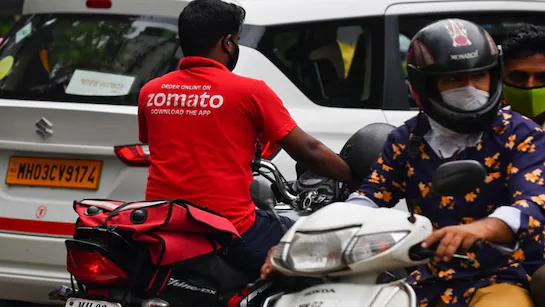
Food delivery apps have become a daily habit for millions of Indians. From quick snacks to full meals, people now depend heavily on platforms like Zomato and Swiggy. While customers enjoy convenience, the situation on the ground for delivery partners often raises serious questions. A recent post by a Zomato delivery rider about low earnings for a long-distance delivery has once again brought the issue of fair pay into public discussion.
Delivery Partner Shares His Experience on Social Media
The issue came to light after a Zomato delivery partner named Naveen Kumar shared a post on X (earlier Twitter). In his post, he showed details of a delivery where he travelled more than 10 kilometres and spent around 46 minutes on the road. For this delivery, he received only ₹62.93.
ट्रिप दूरी: 10.1 किलोमीटर
ट्रिप समय: 46 मिनट
प्राप्त भुगतान: ₹62.93
इतनी अधिक दूरी और समय देने के बावजूद जो भुगतान मिला है, वह मेहनत, समय और पेट्रोल खर्च के मुकाबले उचित नहीं है। लगभग 10 किलोमीटर की डिलीवरी और करीब 1 घंटे के समय के लिए यह राशि बहुत कम है।@zomatocare pic.twitter.com/5o4QjsYjki— naveen kumar (@naveen100591) January 14, 2026
According to Naveen, the payment did not match the effort, time, fuel cost, and traffic challenges involved. He questioned how such an amount could be considered fair for nearly one hour of work and a long-distance trip.
Why the Post Gained Attention
The post quickly gained attention because many delivery partners could relate to the problem. Several riders commented that they often face similar situations, especially during peak hours or bad weather. Long distances, traffic jams, fuel prices, and physical fatigue make such deliveries more difficult, yet the earnings remain low.
“हमें अपनी FE ID बताकर अपनी ID बंद नहीं करानी है।
कंपनी द्वारा किया गया payout सही है या नहीं, इसकी कृपया स्पष्ट जानकारी दी जाए।— naveen kumar (@naveen100591) January 14, 2026
Many users also pointed out that delivery partners have limited freedom to reject orders. If they decline too many deliveries, their order flow may reduce or they may face penalties.
How Delivery Partner Payments Usually Work
Food delivery companies generally calculate payouts based on distance, time, demand, and location. There are also incentives during peak hours or festivals. However, riders argue that the system does not fully consider real-life conditions like road traffic, rain, rising petrol prices, and waiting time at restaurants.
In cities with heavy traffic, even short distances can take a long time. This reduces the number of orders a rider can complete in a day, directly affecting daily income.
Zomato’s Public Response to the Complaint
After the post went viral, Zomato Care responded publicly. The company acknowledged the rider’s concern and said it wanted to understand the issue in detail. Zomato asked Naveen to share his FE (Field Executive) ID and registered phone number through a direct message so that the matter could be checked internally.
The response was polite and followed the company’s usual support process.
Delivery Partner Refuses to Share FE ID
The situation took another turn when the delivery partner refused to share his FE ID. He said that sharing such details could risk his account being blocked or permanently closed. Instead, he asked Zomato to explain clearly how payments for long-distance orders are calculated.
This reply sparked further debate online, with many people supporting the rider’s concern about job security.
Public Reaction and Social Media Debate
Social media users were divided. Some supported Zomato, saying that companies follow fixed algorithms and incentives balance out low-paying orders. Others strongly backed the delivery partner, saying that companies should be more transparent and humane.
Labour experts also highlighted that gig workers do not have the same protections as full-time employees. Since delivery partners are considered “independent contractors,” they often lack fixed income, insurance, and strong grievance systems.
Bigger Question: Are Gig Workers Paid Fairly?
This incident highlights a larger issue in India’s gig economy. While platforms provide employment to lakhs of people, fair pay and working conditions remain a concern. Rising fuel prices and inflation have made it harder for delivery partners to earn enough, especially when payouts do not increase proportionately.
Experts believe that companies should review payment structures regularly and clearly communicate how earnings are calculated.
Conclusion
The Zomato delivery partner’s complaint has once again drawn attention to the challenges faced by gig workers in India. While Zomato has responded and offered to look into the issue, the rider’s hesitation to share personal details shows the fear many workers have about job security.
This incident is not just about one delivery or one rider. It raises an important question about transparency, fair wages, and respect for the people who form the backbone of the food delivery industry. As food delivery apps continue to grow, addressing these concerns will be crucial for building trust with delivery partners.
FAQs
Why did the Zomato delivery rider complain?
The rider complained because he received only ₹62.93 for a delivery that took 46 minutes and covered over 10 kilometres, which he felt was unfair.
How did Zomato respond to the complaint?
Zomato acknowledged the issue and asked the rider to share his FE ID and phone number via direct message to investigate further.
Why did the rider refuse to share his FE ID?
The rider said he feared that sharing his FE ID could lead to his account being suspended or permanently closed.
How are delivery partner earnings calculated?
Earnings are usually based on distance, time, demand, location, and incentives, but riders say real-world challenges are not fully considered.
Is this issue common among delivery partners?
Yes, many delivery partners have raised similar concerns about low pay for long-distance or time-consuming deliveries.