
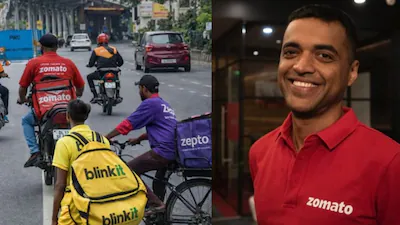
A major debate has erupted across India after Zomato CEO Deepinder Goyal reacted to the nationwide gig workers’ strike held on December 31. His comments on wages, job creation, and the gig economy triggered strong reactions on social media, with many supporting him and many questioning his views.
The discussion has once again brought attention to the working conditions, income, and future of gig workers in India.
What Triggered The Gig Workers’ Strike?
Gig workers from delivery platforms like Zomato, Blinkit, Swiggy, and others called for a nationwide strike demanding:
- Higher monthly income
- Better incentives
- Transparent payment systems
- Improved safety and insurance
One major demand that caught public attention was a monthly income expectation of around ₹40,000, which sparked mixed reactions.
Deepinder Goyal’s Response To The Strike
Deepinder Goyal stated that Zomato and Blinkit were largely unaffected by the strike. According to him, the platforms recorded over 75 lakh deliveries on New Year’s Eve, the highest ever.
One more thing. Our 10 minute delivery promise is enabled by the density of stores around your homes. It’s not enabled by asking delivery partners to drive fast. Delivery partners don’t even have a timer on their app to indicate what was the original time promised to the…
— Deepinder Goyal (@deepigoyal) January 1, 2026
He said the gig economy is one of India’s largest organised job creation systems, and urged people not to believe what he called “misleading narratives” spread on social media.
In his words, if a system was truly unfair, it would not continue to attract lakhs of workers who choose to work in it daily.
Zomato CEO Defends Gig Economy Model
Goyal strongly defended the current gig economy model, explaining that:
Agree. And literally everyone who has a job wants to get paid more. Everyone thinks they deserve better. At the end of the day, market forces decide how much does someone get paid.
Companies reliant on gig economy compete very brutally with each other. Demand is more than the… https://t.co/sXyViQzz25
— Deepinder Goyal (@deepigoyal) January 2, 2026
- Gig work offers flexibility, unlike fixed office jobs
- Many workers choose delivery jobs voluntarily
- Income is decided by market demand and supply
He also pointed out that many entry-level formal jobs in India pay less than what active gig workers earn during high-demand hours.
Explanation On 10-Minute Delivery Controversy
One of the biggest concerns raised online was about 10-minute deliveries, with critics saying it puts pressure on riders.
Goyal clarified that:
- Riders do not see countdown timers
- Orders are packed quickly due to nearby stores
- Average delivery distance is under 2 km
- Average speed is around 15 km per hour, not rash driving
According to him, fast delivery happens because of store density, not unsafe riding.
Admission: “No System Is Perfect”
While defending the model, Deepinder Goyal also admitted that no system is perfect.
He said Zomato is continuously working to improve:
- Safety measures
- Earnings transparency
- Partner experience
- This admission earned him appreciation from some users who felt he was being realistic rather than defensive.
Social Media Reacts: Support And Criticism
The internet was sharply divided.
Supporters Say
- Gig work is optional, not forced
- High wages would increase delivery costs
- Market forces decide fair pay
- Flexibility is a major benefit
Several users argued that demanding ₹40,000 would lead to:
- Higher food prices
- Fewer orders
- Less work for delivery partners
Critics Question Worker Security
On the other hand, critics raised serious concerns:
- No fixed salary
- No job security
- No paid leaves
- Rising fuel and living costs
Stand-up comedian Kunal Kamra openly questioned how much delivery partners earn per hour, asking for transparent data.
Gig Workers’ Union Reacts Strongly
The Telangana Gig and Platform Workers Union said the record number of deliveries was not a success but a sign of financial pressure.
How much did they get paid hourly over the last one year. It’s just another number you have it, give it & end the debate…
If you tell me they were At least paid 50 rupees every hour they were on the app. I’ll never tweet about gig workers again… https://t.co/CRrEe1bXUd— Kunal Kamra (@kunalkamra88) January 1, 2026
According to them, many workers could not afford to log out on New Year’s Eve because incentives were necessary to survive.
Political Leaders Join The Debate
Some political leaders also stepped in.
A Mumbai MP met gig workers and said:
-
Profit should not come above humanity
-
Workers deserve fair wages and dignity
This added a political angle to what was earlier a business and labour discussion.
Business Leaders Back Deepinder Goyal
Several startup founders and business leaders supported Goyal’s views.
They said:
-
Gig platforms are tech-enabled service systems
-
Similar to cab aggregators
-
Pay depends on distance, time, and demand
Paytm founder Vijay Shekhar Sharma compared quick delivery to booking a nearby cab, saying speed is due to availability, not pressure.
Public Opinion: A Divided India
Public opinion remains split.
Some people believe:
-
Gig work is a side income, not a permanent job
-
Flexibility comes with trade-offs
Others believe:
-
Platforms should ensure minimum earnings
-
Rising inflation needs better pay protection
This debate shows the changing nature of work in modern India.
Bigger Question: Future Of Gig Economy In India
India’s gig economy employs millions of workers and continues to grow rapidly.
The real challenge is finding a balance between:
-
Business sustainability
-
Worker welfare
-
Customer affordability
Experts believe future policies may include:
-
Minimum hourly earnings
-
Better insurance coverage
-
Clearer contracts
Conclusion
The debate sparked by Deepinder Goyal’s comments highlights a deep and complex issue. The gig economy has created massive job opportunities, but concerns around income stability and worker rights cannot be ignored.
Both sides raise valid points. While flexibility and market-driven pay are realities, fair treatment and transparency are equally important. The discussion is far from over, but one thing is clear — India’s gig economy needs thoughtful evolution, not emotional extremes.
FAQs
What was the gig workers’ strike about?
The strike was about better pay, incentives, safety, and transparency in gig work platforms.
What did Deepinder Goyal say about the strike?
He said the system is not unfair, highlighted record deliveries, and defended the gig economy model.
Why is the ₹40,000 salary demand controversial?
Many believe it is unrealistic and could increase costs, while others say it matches rising living expenses.
Are delivery riders forced to meet 10-minute targets?
According to Zomato, riders do not see delivery timers and are not pushed to speed.
Is the gig economy good or bad?
It offers flexibility and jobs but lacks long-term security. The truth lies somewhere in between.